
FR / DIGITAL WORKSHOP

BHATKAL, INDIA / SOFTWARE & SYSTEMS

FarisRuknuddin.

From the interface
to the system behind it.

I’m a final-year AI and Machine Learning engineering student at AITM. I build backend and full-stack software in Python and TypeScript, with a focus on reliable APIs and data workflows.

EDUCATIONExpected graduation 2027

OPEN TOSWE internships and graduate roles

Faris Ruknuddin wearing glasses and a navy blazer
Faris RuknuddinEngineer in the making ↗
FARIS / DIGITAL WORKSHOP01
Faris’s detailed studio, with the project monitor, robot and experience board
There’s a room behind the work.Step inside ↗

Digital WorkshopExplore the interactive 3D world.

01 / Backend systems02 / Applied intelligence03 / Security · learning10 selected projects ↓

01 / TOP 10 GITHUB PROJECTS

Ideas, made concrete.

Top 10 public projects across AI reliability, backend systems, quant analytics and local-first software. Open any case study for architecture decisions, verification evidence and explicit scope limits.

Featured 06Selected 04Also built 11Systems 06AI systems 03ML tooling 01
06 CASE STUDIES
01 / AI systemsFeaturedAI reliability & security

TraceGuard

Causal multi-agent failure attribution (C³-Attributor), CaMeL-inspired prompt-injection capability firewall and time-travel counterfactual replay for OpenTelemetry GenAI traces.

PythonFastAPIReact 19TypeScriptOpenTelemetry
Read case study

The problem

Multi-agent LLM pipelines fail silently across cascading tool calls and untrusted prompt inputs, making root-cause localization and security enforcement difficult with passive logs alone.

What it does

  • C³-Attributor extracting 23 structural, graph, taint and semantic features from OpenTelemetry GenAI spans with HistGradientBoosting step-fault ranking and RandomForest MAST classification
  • Deterministic counterfactual time-travel replay verifying whether patching a candidate step recovers a failed or compromised trace
  • CaMeL-inspired prompt-injection classifier (TF-IDF + Logistic Regression) paired with a provenance taint lattice blocking tainted external sinks and human-in-the-loop policy approval
  • React 19 + TypeScript forensic workstation, FastAPI WebSocket stream, MCP server and HMAC-SHA256 signed n8n webhook dispatcher

Architecture & decisions

A 4-agent diagnostic council (SecurityTaintAuditor, SpanIngestorAgent, CausalLocalizerAgent, CounterfactualVerifierAgent) runs under a supervisor with contradiction detection and fault isolation.

SQLite WAL persists traces, taint policies and audit records while an MCP server and SSRF-protected HMAC webhook layer integrate with external agents and automation workflows.

My contribution

Architected and built the C³-Attributor pipeline, CaMeL capability firewall, counterfactual replay engine, forensic React workstation, MCP server and evaluation suite.

Implementation & evidence

  • 15 passing automated pytest tests and a held-out synthetic benchmark comparing C³-Attributor against rule, heuristic and ablation baselines.
  • Indirect prompt-injection classifier evaluated on unseen test families (F1 = 0.8571, ROC-AUC = 0.9508 vs 0.5505 keyword baseline) with explicit synthetic-benchmark caveats documented.

Scope & limitations

  • Local forensic workstation; benchmark scores are measured on structured synthetic multi-agent datasets documented in KNOWN_LIMITATIONS.md.
  • Production deployment requires environment-specific OTel collector ingestion and enterprise identity integration.
02 / AI systemsFeaturedCausal digital twin

PARALLAX v2.0

Neuro-symbolic multimodal causal digital twin & counterfactual resilience engine fusing invertible SCMs, FLIR/optical inspection, an 8-agent council and SHA-256 governance.

PythonFastAPIReactTypeScriptNetworkX
Read case study

The problem

Single-LLM log chatbots confuse downstream error cascades with upstream root causes and cannot safely verify physical or infrastructure interventions before execution.

What it does

  • Vectorized hinge-spline invertible Structural Causal Model with Monte Carlo Shapley root-cause attribution, Granger lead-lag discovery and sensor-freeze visual imputation
  • Side-by-side FLIR radiometric IR (24×32 thermal grid + cursor probing) and macro optical hardware inspection anchored to a 14-node interactive causal DAG
  • 24-step Monte Carlo Pearl do(X := x) recovery trajectories with fail-closed symbolic safety invariants, reverse-order rollback and automatic plan failover
  • 8-agent neuro-symbolic council (local Ollama with deterministic fallback), SHA-256 hash-chained audit ledger and FastMCP protocol server across 6 React workspaces

Architecture & decisions

Separates deterministic causal/symbolic verification and prompt-injection sanitization from LLM synthesis so unsafe hardware directives are hard-blocked before execution.

Uses SQLite WAL with FTS5 BM25 + SVD dense vector RRF retrieval and an append-only SHA-256 provenance ledger streamed over SSE to the React console.

My contribution

Engineered the invertible SCM and causal discovery engines, multimodal vision segmentation, 8-agent council, counterfactual simulator, governance ledger and 6-workspace console.

Implementation & evidence

  • 18 passing automated unit, security, concurrency and MCP tests alongside a 12-case comparative cyber-physical fault benchmark.
  • Full Docker Compose and Nginx SSE reverse-proxy setup with interactive scenarios covering cascade faults, prompt injection and actuator failure rollback.

Scope & limitations

  • Cyber-physical hardware telemetry, FLIR frames and actuator responses are simulated fixtures documented transparently in KNOWN_LIMITATIONS.md.
  • Live GPU LLM synthesis requires local Ollama; falls back cleanly to deterministic structured synthesis when unavailable.
03 / AI systemsFeaturedMulti-agent IT operations

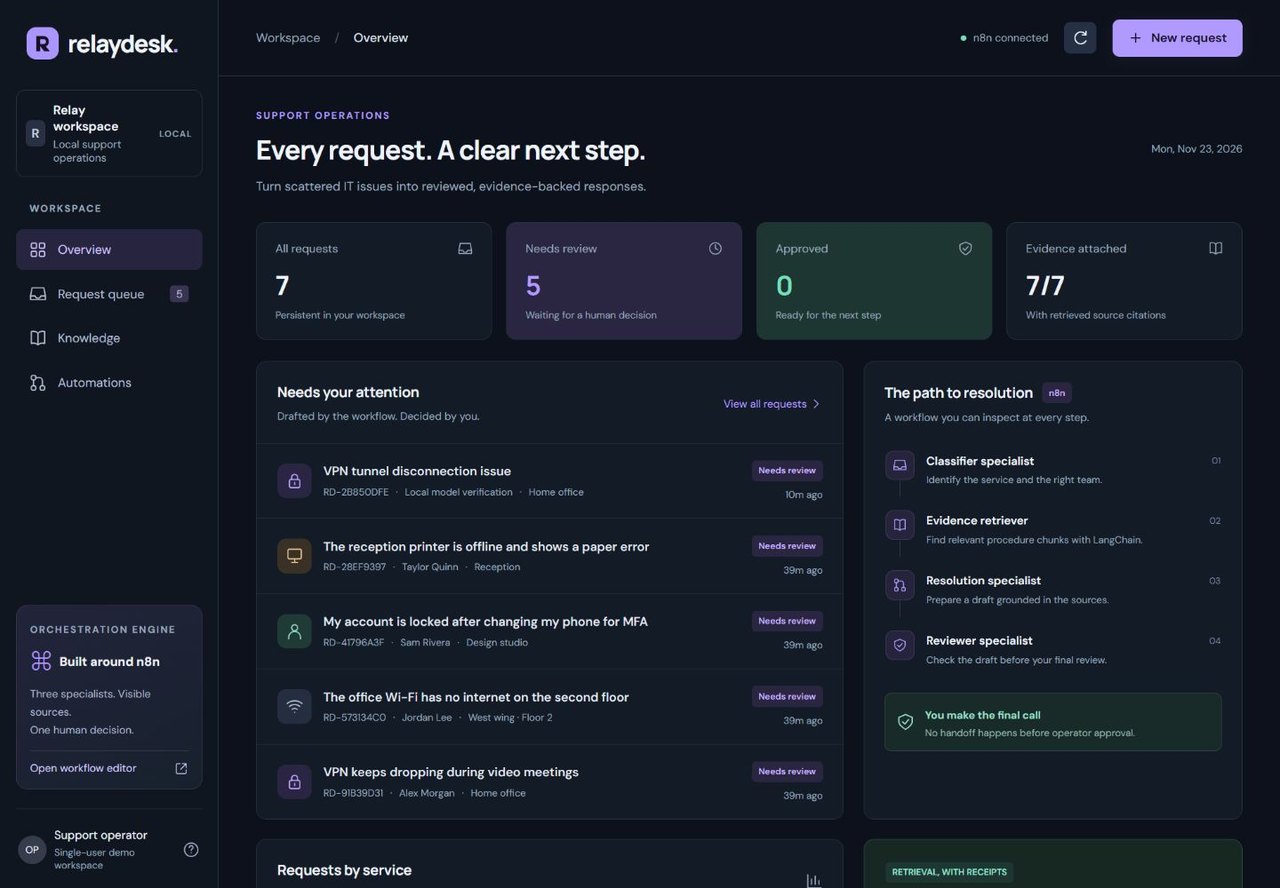
RelayDesk 2.0

Voice-enabled IT support workbench orchestrated in n8n with multi-agent Ollama LLMs, durable SQLite worker and cached hybrid RAG.

PythonFastAPIJavaScriptn8nLangChain
Read case study
RelayDesk 2.0 voice-enabled IT support operations dashboard
Operator workbench — screenshot from the project repository.

The problem

Support teams need automated triage and drafting that remain inspectable, recover cleanly from worker failures and never act without human approval.

What it does

  • Three native n8n specialist LangChain agents (Classifier, Resolution, Reviewer) powered by local Ollama models
  • Durable SQLite job queue and independent Docker worker with lease tokens, heartbeats, lease reclamation and exponential backoff
  • Versioned hybrid lexical RAG combining BM25Okapi and 3-gram cosine similarity via RRF with a 128-entry LRU cache
  • Voice dictation and speech synthesis portal, retrieval playground, atomic approval outbox and defense-in-depth safety boundaries

Architecture & decisions

Browser or voice requests enter a durable SQLite job queue; a separate worker container claims leases, dispatches signed 30-second HS256 JWT webhooks to n8n and streams stage callbacks back to the operator console.

Pre-ingress secret redaction, prompt-injection detection, hazard withholding and hallucinated-citation rejection guard the pipeline; optimistic versioning and BEGIN IMMEDIATE transactions guarantee exactly one outbox event per approval.

My contribution

Architected and built the full v2 workbench, durable worker, n8n multi-agent workflows, cached hybrid retriever and verification suite.

Implementation & evidence

  • 29 passing pytest tests (86% service coverage) and 19 passing Node workflow tests cover persistence, leases, safety boundaries and n8n orchestration.
  • Local retrieval benchmark measured a 6.7× speedup with the versioned cache (0.98 ms cached vs 6.63 ms uncached); live 3-agent Ollama execution verified end-to-end.

Scope & limitations

  • Local release running on loopback Docker services; optional IMAP email intake stays disabled until configured.
  • Browser microphone recognition quality and spoken playback depend on the user’s OS and browser Web Speech support.
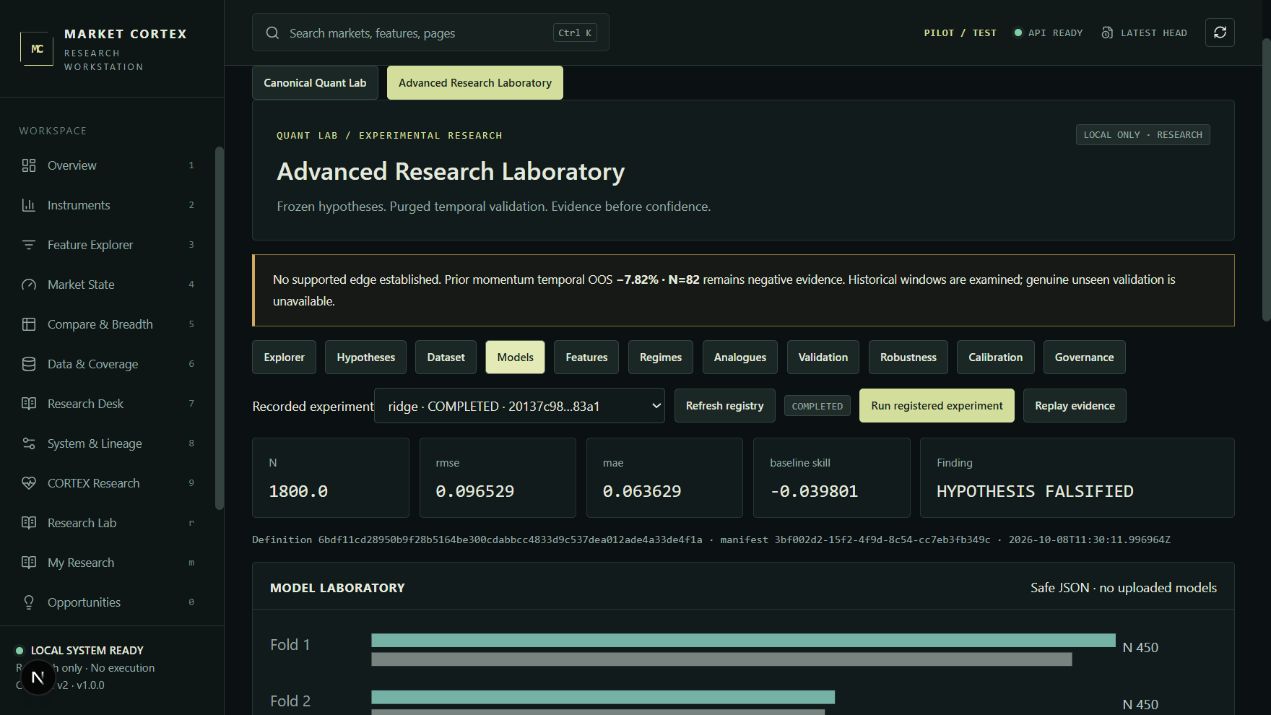
04 / SystemsFeaturedPoint-in-time quant research

Market Cortex

Local-first point-in-time market data, analytics and evidence-grounded quantitative research spanning Phases 1–12.

PythonFastAPIPostgreSQLParquetDuckDB
Read case study
Market Cortex Advanced Research Laboratory workstation
Research workstation — screenshot from the project repository.

The problem

Market research becomes difficult to trust when changing data, stale observations and undocumented assumptions are mixed together.

What it does

  • Versioned daily-bar contracts, provenance, quarantine rules and strict as-of selection across content-addressed Parquet manifests
  • Next.js research workstation with candlesticks, Feature Explorer, explainable market regime state, opportunity detectors and risk views
  • Quant Lab for canonical replay, walk-forward selection and seeded Monte Carlo alongside CORTEX bounded cited research missions

Architecture & decisions

Immutable Parquet artifacts are published through atomic dataset manifests; PostgreSQL stores identity, jobs, outbox and operational metadata while DuckDB queries pinned artifacts.

Analytics, Quant Lab and CORTEX research tools enforce explicit as-of manifests, skeptic passes and inspectable citations rather than silently mutating historical inputs.

My contribution

Designed, architected and built the local-first research platform, integration surface and five-pair Binance pilot including ingestion, backup and isolated restore.

Implementation & evidence

  • Phases 1–12 implemented with PostgreSQL 17 integration tests, encrypted backup and separate restore verification.
  • Documents empirical findings honestly, including negative out-of-sample backtest evidence rather than claiming an unverified edge.

Scope & limitations

  • Live India/US feeds, event calendars, option chains and licensed news remain deferred pending credentials and verified mappings.
  • No order execution endpoints or proven investment edge are claimed.
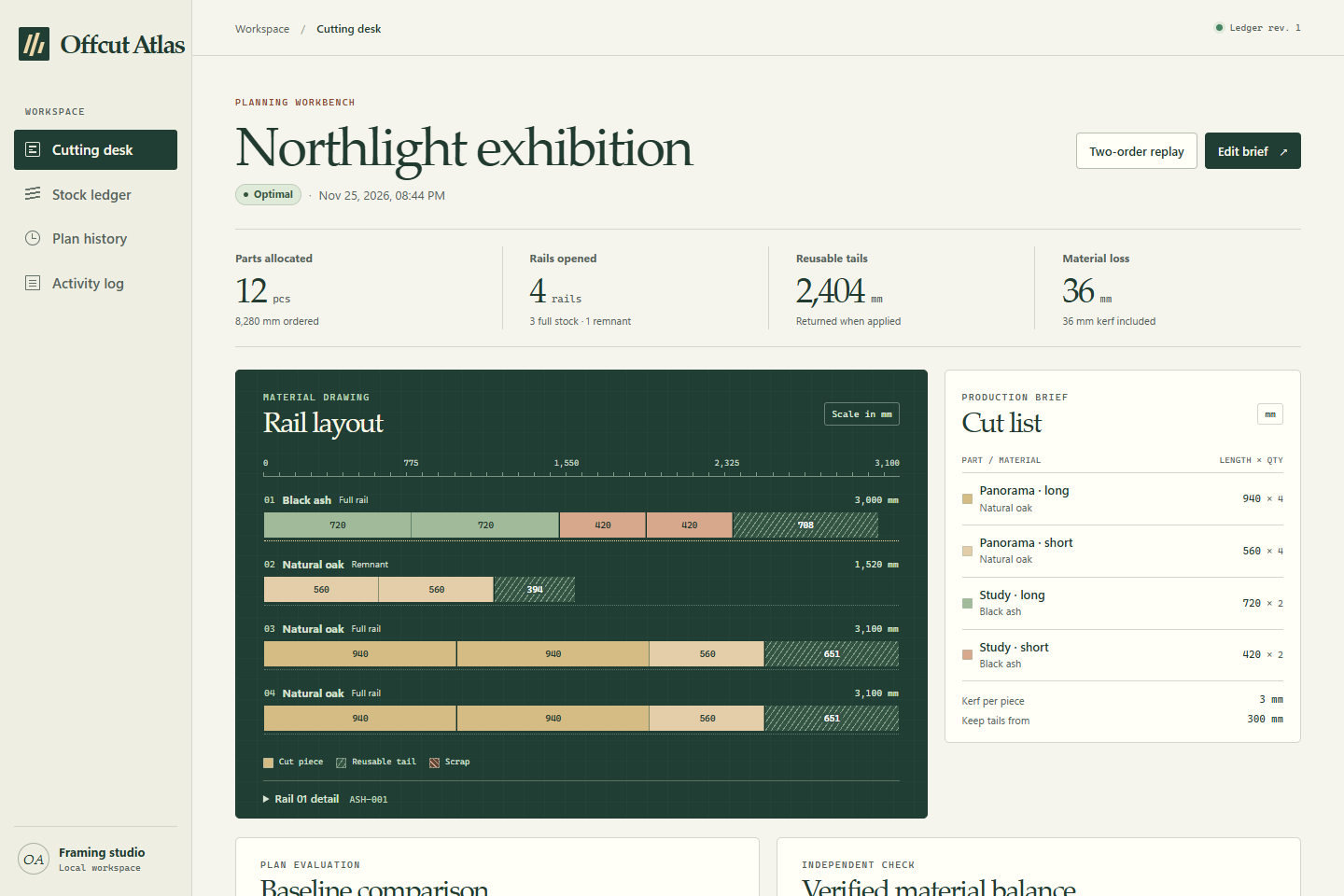
05 / SystemsFeaturedMaterial optimization & ledger

Offcut Atlas

Local-first material planning workbench for framing studios with verified cut drawings, traceable offcut racks and two-order lookahead.

Python 3.12SQLiteJavaScriptHTML/CSSDocker
Read case study
Offcut Atlas cutting desk with scaled rails for a framing commission
Cutting desk — verified cut drawing from the repository.

The problem

Custom framing workshops waste expensive moulding lengths when cut lists ignore reusable offcuts, kerf allowances and upcoming commissions.

What it does

  • Exact single-order cutting-stock solver minimizing fresh rails opened, irreversible millimetre waste and total rails handled with full kerf accounting
  • Two-order lookahead replay comparing separate vs. joint planning across inventory transitions and remnant retention thresholds
  • Atomic SQLite stock ledger, printable shop cut sheets with remnant labels, plan history and offline verifiable feasibility packets

Architecture & decisions

Built strictly on the Python 3.12 standard library with zero external runtime packages; ships all browser assets and an independent CLI packet verifier (python -m atlas.check).

Separates the cutting solver, two-order lookahead horizon engine, transactional SQLite stock ledger and revisioned plan snapshots so stale plans cannot double-book physical rails.

My contribution

Designed and built the cutting-stock optimizer, two-order lookahead simulator, transactional stock ledger, printable shop sheets and verification checker.

Implementation & evidence

  • On the synthetic Northlight exhibition benchmark (12 pieces, 8,280 mm), uses 4 rails with 36 mm loss vs. 7 rails and 536 mm loss for the greedy baseline.
  • Includes offline feasibility proof export, GitHub Actions CI checks and Docker packaging.

Scope & limitations

  • Designed as a single-studio local workbench (up to 128 rails and 96 requested pieces per order); multi-site ERP sync is outside scope.
06 / SystemsFeaturedLive demoMarket research · Live demo

CRYPTOZ

Crypto market research workstation with live Binance/Coinbase feeds, editable technical charts, market breadth, forecasts and paper trading.

JavaScriptViteBinance APICoinbase APIVercel
Read case study

The problem

Retail crypto dashboards often mix unverified narratives with bloated layouts instead of transparent exchange quotes, clean charting and honest paper-trading studies.

What it does

  • Unified Home dashboard with live prices, Bitcoin history ranges, market breadth, publisher-linked news and a 2,000-asset searchable directory
  • Interactive Charts workspace with technical indicators, automatic and manual drawings, depth view and 1–48 candle forward study projections
  • Separate Binance spot USDT and Coinbase spot USD instrument identities with USD/INR display conversion and native-unit order/export integrity
  • Dedicated Practice paper-trading desk and Learn workspace with persisted watchlists, themes and CSV exports

Architecture & decisions

Streams real-time Binance ticker deltas directly into next-frame UI updates while clearly distinguishing fresh stream observations from cached snapshots.

Deployed as a lightweight static frontend with serverless route proxies on Vercel and comprehensive design/forecast documentation.

My contribution

Rebuilt and engineered the full CRYPTOZ research terminal, streaming market directory, charting workspace, paper-trading flow and Vercel deployment.

Implementation & evidence

  • Live public production deployment on Vercel serving real-time Binance USDT and Coinbase USD market data.
  • Replaces hardcoded narratives with transparent, documented market sources and dated ECB FX cross rates.

Scope & limitations

  • Paper-trading and research workstation only; does not execute live exchange orders or provide financial advice.
  • Bulk quote directory coverage depends on upstream public exchange API rate limits.

Selected projects

04 CASE STUDIES
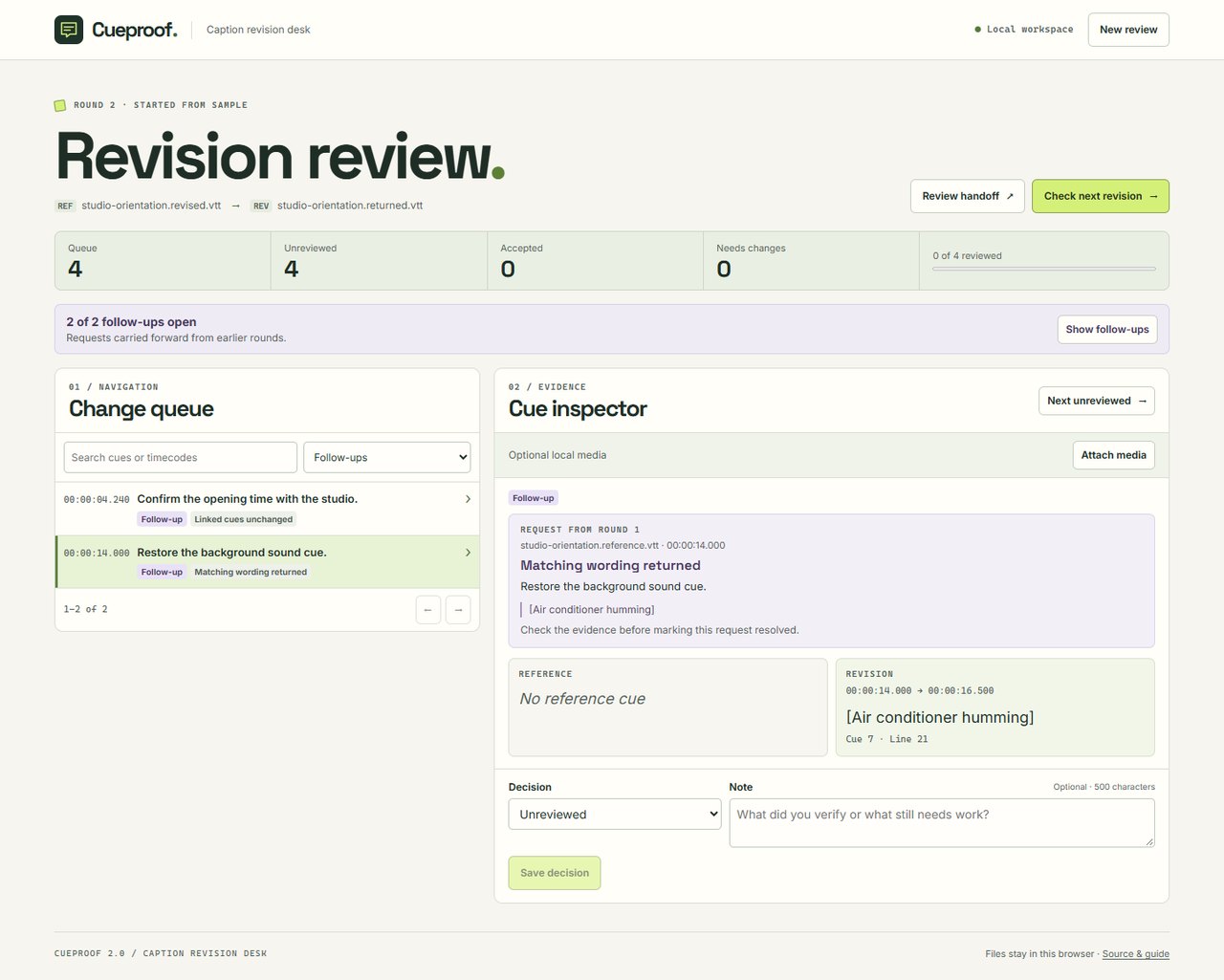
07 / SystemsLive demoCaption review · Live demo

Cueproof

Compare two SRT or WebVTT caption tracks in the browser, review changes against video and hand off timecoded feedback.

TypeScriptViteIndexedDBPlaywright
Read case study
Cueproof browser caption revision desk
Caption review desk — screenshot from the project repository.

The problem

Caption revisions are hard to review when wording diffs, timing drifts and follow-up decisions live in separate tools.

What it does

  • Order-preserving SRT and WebVTT alignment with inline word diffs, inferred shifts and split/merge proposals
  • Synchronized media playback at a cue, readability advisories and a keyboard-friendly review queue with notes
  • Multi-round follow-up resolution tracking, CSV editor handoffs and portable IndexedDB JSON backups

Architecture & decisions

Parsing, diff alignment and media playback run completely client-side with IndexedDB storing tracks and decisions on the device.

Portable JSON backups preserve both tracks, notes and follow-up evidence while attached media remains local to the current tab.

My contribution

Designed and built the caption alignment engine, multi-round review desk, IndexedDB persistence and automated CI publishing.

Implementation & evidence

  • Public live demo opens with synthetic captions and multi-round sample returns.
  • GitHub Actions workflow runs verification tests before publishing to GitHub Pages.

Scope & limitations

  • Checks cover UTF-8 SRT and WebVTT formats. A reviewer still verifies wording, sounds and timing against the video.
08 / SystemsKitchen operations

Shelfday

A daily stock and prep workbench that reconciles ingredients, portions, sales and waste with FEFO batch expiry.

TypeScriptReactVinextCloudflare D1SQLite
Read case study

The problem

Small kitchens need to know which stock to use first and reconcile what happened before closing the day.

What it does

  • Earliest-expiry-first (FEFO) allocation across eligible ingredient batches with atomic shortage rollback
  • Explainable prep suggestions based on comparable closed weekdays and combined recipe restock requirements
  • Locked closing records, complete activity history, CSV export and validated JSON backup and restore

Architecture & decisions

A deterministic domain engine validates a whole operation before applying it so partial cancellations restore exact lots without breaking expiry order.

User-scoped persistence checks record revisions and idempotent operation IDs via compare-and-swap writes so concurrent or repeated requests cannot silently overwrite stock.

My contribution

Designed and built the kitchen workflow, atomic stock engine, persistence layer and responsive operations interface.

Implementation & evidence

  • Repository tests cover stock allocation, shortage rollback, duplicate operations and conflicting writes.
  • The verification record documents the local browser flow and database checks.

Scope & limitations

  • The hosted kitchen requires the owner’s sign-in; published acceptance evidence covers local workflows.
  • Prep suggestions and ingredient costs are operational estimates, not accounting valuations.
09 / SystemsDeadline & compliance intelligence

Vigil

Local-first unified deadline, compliance, license and contract intelligence platform with automated risk prioritization.

TypeScriptReactViteTailwind CSSExpress
Read case study

The problem

Licenses, vendor contracts, SSL certificates and insurance policies scattered across spreadsheets and email threads silently lapse and trigger penalties.

What it does

  • Unified tracking across licenses, contracts, certifications, warranties and subscriptions with document attachments and audit trails
  • Deterministic 0–100 risk engine combining days until expiry, financial impact, category defaults and automatic critical flagging under 7 days
  • Configurable multi-threshold alert rules (90 to 1 day), interactive risk/category charts and CSV/JSON import and export

Architecture & decisions

A React 18 TypeScript workspace communicates with a local Express REST API separated into route handlers, domain services and a dedicated risk engine.

Uses Node.js native node:sqlite in synchronous WAL mode with zero native C++ build dependencies so the full compliance center runs locally out of the box.

My contribution

Built the full-stack compliance command center, risk scoring engine, alert rule system, SQLite persistence and integration tests.

Implementation & evidence

  • Includes full CRUD item management, document storage, dashboard analytics, bulk operations and server integration tests.
  • Ships with seeded realistic sample data for immediate local inspection without external accounts or cloud dependencies.

Scope & limitations

  • Designed as a self-hosted local-first command center; multi-tenant cloud sync and external SMTP/webhook delivery require user configuration.
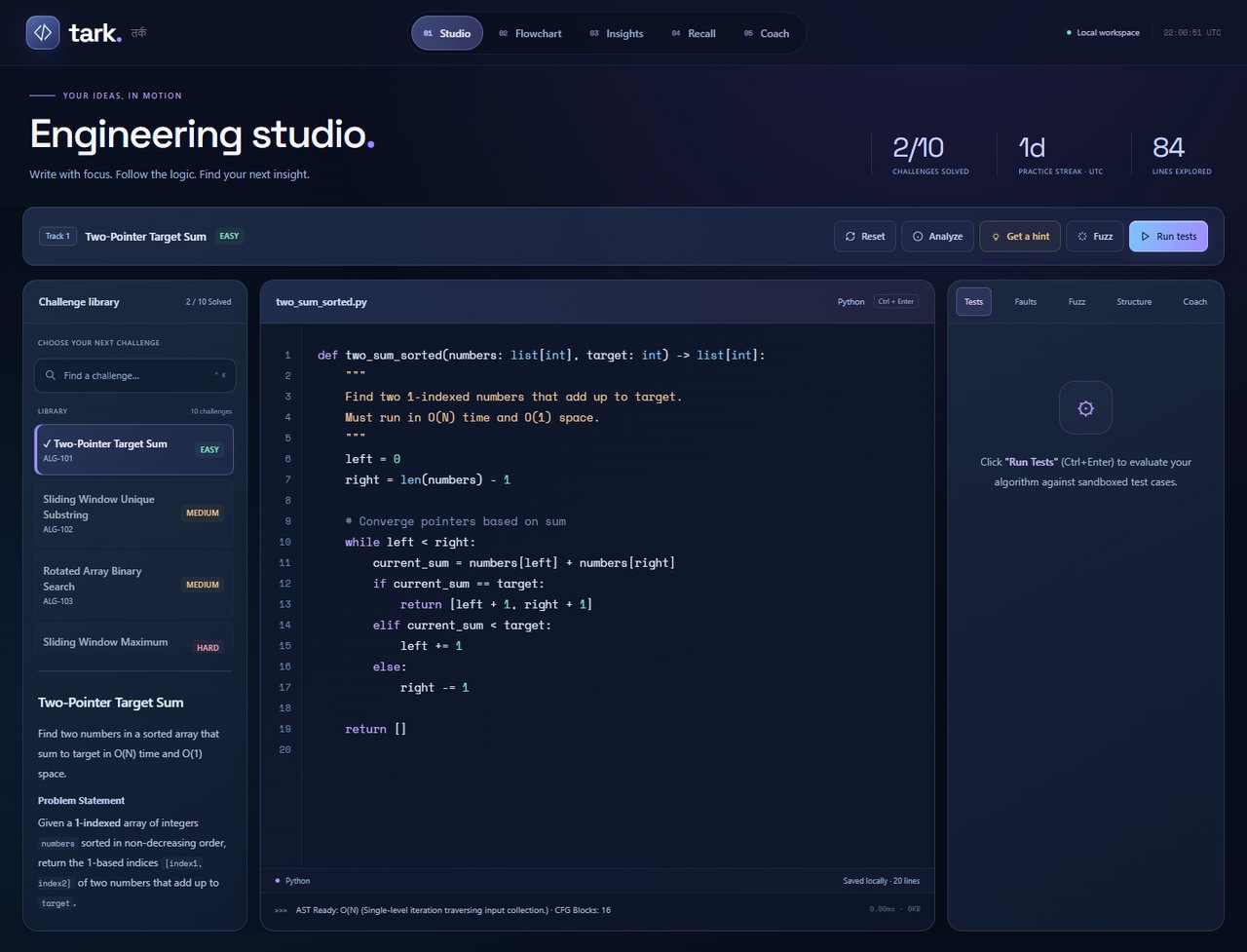
10 / ML toolingAST code studio

TarkAI

A local Python practice studio combining AST static feedback, Halstead metrics, test execution and Leitner spaced review.

PythonFastAPIPydanticSQLiteMermaid
Read case study
TarkAI Obsidian Python AST practice studio
Obsidian studio — screenshot from the project repository.

The problem

Learners need structured diagnostic feedback on how their algorithms work before seeing a complete answer.

What it does

  • Python 3.12 AST semantic introspection for heuristic complexity estimates, loop nesting and static anti-patterns
  • Halstead metrics, offline Mermaid execution flowcharts and 3-tier Socratic mentoring hints
  • Timed subprocess test runner with tracemalloc tracking and a 5-box Leitner spaced repetition schedule

Architecture & decisions

Static AST analysis and the timed subprocess runner use separate FastAPI endpoints so structural inspection completes before code executes.

SQLite persists submissions and review intervals while the browser preserves active drafts across workspace switches.

My contribution

Built the local coding studio, AST analyzer, Halstead metrics, Socratic hint tiers and verification suite.

Implementation & evidence

  • 33 automated API and engine tests exercise static analysis, challenge discovery and result formatting.
  • Includes a runnable Obsidian studio UI with zero external AI dependency.

Scope & limitations

  • Complexity estimates are static heuristics based on source structure.
  • Subprocess timeouts target trusted local practice; hosted execution of arbitrary untrusted code is outside scope.

Also built & contributed to

11 ADDITIONAL PROJECTS

Alongside the top 10 case studies above, I have built and collaborated on additional systems spanning clinical interoperability (FHIR R4), computer vision, document graphs, hospital management and ML data-leakage detection.

  • Kuber Data Core

    GitHub ↗

    Local financial research workstation for bounded document extraction, FIBO relationship graphs and repeatable DAG pipelines.

    Python · FastAPI · NetworkX · SQLite
  • Vaani Clinical

    GitHub ↗

    Educational clinical intake simulation turning guided encounters into structured SOAP notes and HL7 FHIR R4 bundles.

    Python · FastAPI · Pydantic · SQLite
  • NephroGuard & ShiftPass

    GitHub ↗

    Zero-dependency local renal review and clinical I-PASS handoff training workspace with SQLite persistence and FHIR R4 export.

    Python · SQLite · FHIR R4 · JavaScript
  • Mendroom

    GitHub ↗

    Local intake, skill-aware volunteer matching and repair journal for community repair cafés with transactional backups.

    TypeScript · React · Express · Zod
  • LabLens

    GitHub ↗

    Hands-free electronics lab mentor connecting ONNX component detection and MediaPipe pointing with page-cited datasheet retrieval.

    Python · ONNX · MediaPipe · Streamlit
  • Adaptive Traffic Signal Control

    GitHub ↗

    Real-time OpenCV traffic signal optimizer with adaptive MOG2 queue-density green timing and emergency vehicle preemption.

    Python · OpenCV · NumPy
  • Omnimate Healthcare System

    GitHub ↗

    Containerized hospital-management stack with Laravel 12 API, Next.js 15 frontend, transactional FEFO pharmacy dispensing and billing.

    Laravel · PHP · Next.js · PostgreSQL
  • CaseVault

    GitHub ↗

    Collaborative case document and evidence management with encrypted storage, role-based access controls and tamper-evident audit logs.

    Python · FastAPI · SQLAlchemy · Cryptography
  • Collaborative clinic voice-receptionist platform with LiveKit realtime audio, Sarvam/Gemini integrations and FastAPI dashboards.

    Python · FastAPI · React · LiveKit
  • Omnimate Shots

    GitHub ↗

    TypeScript API for screenshot directory watching, JSON metadata indexing and filtered HTTP search.

    TypeScript · Node.js
  • LeakageGuard

    Private repo

    Final-year B.E. ML tooling detecting preprocessing, duplicate, group and temporal data leakage via Python AST and dataset checks.

    Python · AST · pandas · Jinja2

02 / THE ENGINEER

The person
behind the projects.

I’m Faris, a full-stack software engineer from Bhatkal and a final-year B.E. student in Artificial Intelligence and Machine Learning at AITM. I founded Omnimate and led a seven-person team delivering client software. My internships covered retail software, applied AI, machine learning and cloud infrastructure.

I like understanding how the pieces fit: an interface someone can use, the services behind it, and the data moving between them. I put real effort into verifiable engineering—writing clean tests, handling failure modes upfront and keeping state inspectable.

I’m learning cybersecurity, with an interest in applying it to software engineering.

Backend & APIs
Python, FastAPI, Express, Laravel, TypeScript, Docker Compose, MCP
Local-First & Data
SQLite (WAL/FTS5), PostgreSQL, DuckDB, Parquet, Cloudflare D1, IndexedDB
Applied AI & Security
Multi-Agent (n8n, Ollama), OpenTelemetry GenAI, Prompt-Injection Firewalls, Causal SCMs, RAG
Interfaces & Testing
React 19, Next.js, Astro, Three.js, Vite, Playwright, pytest
Request my résumé by email ↗
  1. Mar 2026–Present

    Omnimate

    Founder & Chief System Analyst

    Led a seven-person delivery team, built the Omnimate Shots screenshot search API, and contributed to Vox AI and Omnimate Healthcare.

  2. Feb–May 2026

    Hadi and Taimur AI

    AI Intern

    Built data extraction microservices and a pipeline that used engagement data to generate and schedule social media posts.

  3. Feb–May 2025

    MyJobGrow

    Cloud Computing Intern

    Deployed and monitored apps on AWS and GCP, configured VPCs and EC2, and supported CI/CD and cloud cost reviews.

  4. Oct 2024–Jan 2025

    Acmegrade

    AI/ML Intern

    Trained classification and predictive models using feature engineering, hyperparameter tuning and cross-validation.

  5. Aug–Oct 2026Bengaluru

    MR Tech Industries

    Intern

    Developed retail software, including a mall services management system.

03 / START A CONVERSATION

Have something
worth building?

GitHub ↗LinkedIn ↗Request résumé by email ↗